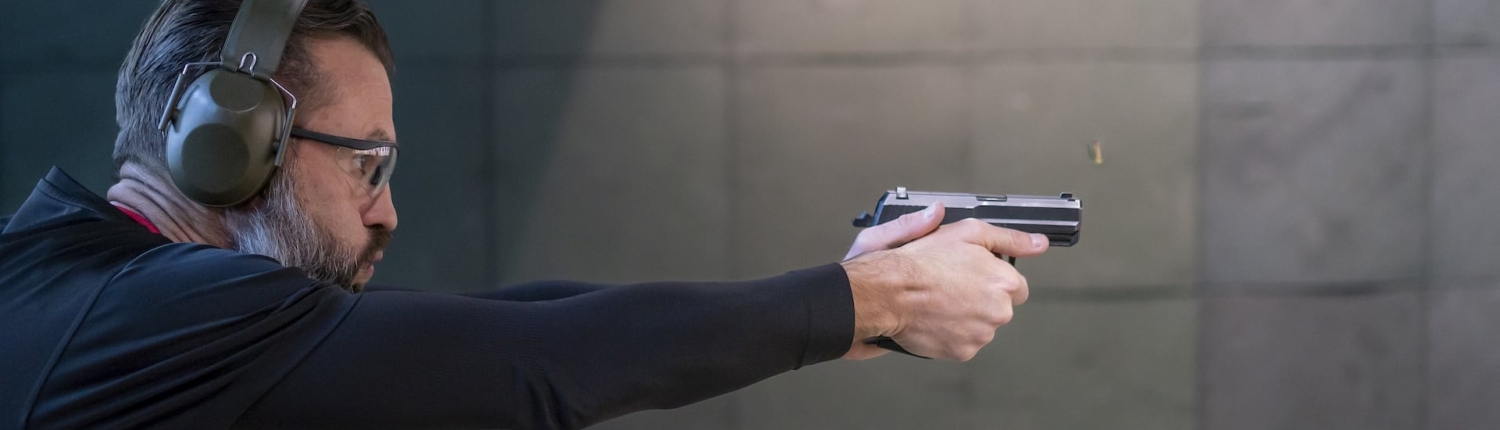
Handgun Manipulation ― Reloads: Series 7
Handgun manipulation skills include a variety of operations that include, but are not limited to, reloads, slide lock, slide release, and clearing malfunctions. Anytime you are conducting a handgun manipulation, particularly during a critically dynamic situation, the handgun should be in a retreated position close to your body for better control and retention. The handgun should be held high, slightly below your line of sight so you can detect movement from the front and the side with your peripheral vision as well as maintaining visual association with your handgun. This method is referred to as your workspace. It should be noted, in a critically dynamic situation or in defensive competition, the handgun manipulation activities shall be conducted from behind proper cover or the cover that is available.
Reloads
There are three basic and accepted reloads for Handgun Manipulation include the Tactical Reload (Tac-Load), the Reload with Retention (RWR) and the Slide-Lock Reload (Emergency Reload).
By definition, the Tactical Reload, which for some is the most difficult to master efficiently, consists of re-charging your partially depleted magazine during a lull in the action by:
- Retreat your handgun to your workspace while simultaneously drawing a spare magazine from your magazine carrier prior to ejecting the partially depleted magazine from your handgun. Remove the fully charged magazine from the magazine carrier by grasping the magazine with your thumb, index finger and your middle finger, palm up, leaving a space between your ring finger and your little finger.
- Release the partially depleted magazine into this open space of your palm and retain the magazine with your ring and little finger for future use.
- Rotate the fully charged magazine by aligning it with the magazine well on your handgun and insert the magazine making sure it is completed seated.
- Secure the partial magazine previously removed in a pocket or magazine carrier. Word of advice, it is much more efficient to secure the partially depleted magazine in a pocket rather than trying to secure it in a magazine carrier.
- Return to a defensive posture.
I have been asked why the tactical reload is so important when chances are, if you are in a defensive situation, you will most likely run the gun dry then do an emergency reload. To some extent this is true particularly with folks who do not train on a regular basis and even if you do, the psychological effects of defensive situation can affect your ability to perform as required and you just might do a complete magazine dump without even realizing it then require an emergency reload. However, if you are in situation when there is a lull in the action and you have adequate cover, you should always do a tactical reload especially before you move from that position because you don’t know what or how many additional threats you may encounter after you move and the tactical reload assures you that your handgun remains at least partially charged for the longest period prior to changing the magazine. There are other reasons for completing this type of reload but are beyond the scope of this article.
By definition, the Reload with Retention is remarkably similar to a Tactical Reload with the following exception. While retreating your gun to your workspace position, you will release the magazine, retain the magazine in your support hand, secure the magazine for future use then recharge your handgun with a fully loaded magazine and assume a defensive posture. The only difference with the reload with retention is, you release and secure the magazine prior to removing the fully charged magazine from your magazine carrier and installing it into your handgun until it fully seats. Some prefer this method but in reality, your gun is not fully charged for a slightly longer period of time. Once again, the reload with retention is performed when there is a lull in the action; performed from behind available cover and completed prior to moving to the next position. The reload with retention is performed by:
- While retreating your firearm to your workspace, release and retain the partially depleted magazine from your handgun with your support hand and secure it for future use if required.
- Secure the partial magazine in a pocket or magazine carrier. Word of advice, it is much more efficient to secure the partially depleted magazine in a pocket rather than trying to secure it in a magazine carrier.
- Retrieve your fully charged magazine from the magazine carrier and insert it into the magazine well of your handgun until it is fully seated.
- Return to the defensive posture.
By definition, the Slide-Lock Reload or Emergency reload is the process of recharging your firearm after all the rounds have been depleted and the slide is locked back due to a deficiency of additional rounds. This reload is the easiest to master and for the most, is the reload that is most commonly used.
The Slide Lock reload is performed by the following process:
- While retreating your handgun to your space, drop the depleted magazine while securing the fully charged magazine from your magazine carrier.
- Retrieve the spare magazine and rotate it toward the magazine well of your handgun.
- Insert the spare magazine into your handgun until it is fully seated.
- Return to a defensive posture if required by rotating your firearm, re-establishing a proper grip and start your press out releasing the slide with your support hand thumb as you initiate your press out.
About the author
Lew Soccorsi brings over 32 years of experience as a firearms instructor, sharing his extensive knowledge and insights on firearms training and safety through the Civilian Defense Training Blog. Specializing in NRA Basic Pistol, Concealed Carry, and advanced tactical training, Lew offers expertise across various levels of Tactical Handgun and Carbine instruction. He holds certifications as an NRA Basic Pistol and Range Instructor, a Handgun Instructor through Sig Academy, and numerous tactical certifications, including a Master Gunsmith Certification. Lew’s depth of experience makes him an invaluable asset to our team.
 The Basics Concepts for Concealed Carry: Intermediate Development Skills: StanceApril 21, 2025 - 7:10 am
 The Basics | Concepts for Concealed Carry: Handgun Manipulation ― ReloadsApril 7, 2025 - 6:55 am




Leave a Reply
Want to join the discussion?Feel free to contribute!