
The Basics Concepts for Concealed Carry: Accessories ― Series 3
Now that we have selected our handgun and have recommendations for a caliber, we need to choose a quality gun belt, holster, and mag pouch. Again, after years of trial and error of trying different material, styles, and manufactures, I really like Blade Tech products. Now understand, I am not saying that these products are the best nor am I saying this is the only product you should consider. What I am saying is, these are the products that I have found to work best for my applications.
Gun Belt
Some folks ask why I needed a specialized gun belt when I already have enough regular belts. Regular belts are not stiff enough to be considered a good gun belt. When you draw your firearm, particularly when you are drawing fast, regular belts have way to much deflection to make your draw with efficiency because they lack the stiffness to resist the force generated when drawing the firearm from the holster. In essence, with a regular belt, the belt absorbs the draw stroke energy, has a considerable amount of deflection and in most cases actually inhibits you from making a smooth, clean, and effective draw. It also makes for an uncomfortable means of just carrying the firearm due to the permanent set in the deflection due to the weight of firearm. Of all the belts I have tried, the Blade Tech Ultimate Carry Belt works flawlessly for me in competition, Concealed Carry , and normal dress applications. It is designed with a stiff polymer core; it has inherent capabilities for everyday carry, is made to manage the added weight of a firearm while sparing the bulk and is available in assorted colors. This gun belt can be adjusted in fine increments on the fly without having to undo the ratcheting belt buckle and it is made to be tough and resilient. The water-resistant materials and the ratcheting system is rated at 1,300 lbs. of tensile strength. I have been using mine for a number of years, and it might just be the last belt I will ever buy.
Holster
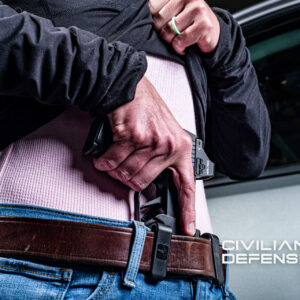
The basic choices for holster material is leather, kydex or nylon. I have all three types of these holsters, and I use them depending on the specific application for which they will be used. I use leather holsters made by Safariland that have a composite core between an inner and outer layer of leather. I use this holster for specific handguns because it protects the firearm from holster wear a little better than kydex and it is efficient in terms of the draw stroke. The downside to this holster is, it can be difficult to get one specifically made for your firearm and leather has a little more friction between the holster and the firearm for the initial release. Also, depending on the design, some leather holsters can collapse after drawing your firearm making it somewhat difficult to re-holster. My go to holster for the majority of my application is the kydex holster with the tek-lok system from Blade Tech. Kydex is virtually indestructible, water and oil resistant, maintains its shape for easy re-holstering and, an argument can be made that kydex can be a little more efficient in terms of initial release of the draw stroke. Some say that kyex is not comfortable to carry because of the stiffness of the holster not giving in dynamic use. I have found this not to be an issue whether shooting competitions where you engage targets from various positions and are required to move from cover to cover, or normal EDC, it simply works great for me in all application. It can be a little difficult getting the seat belt to engage when driving with a kydex holster, but you get used to that. When it comes to Nylon, I am not an enthusiastic fan of nylon holsters unless they are specifically designed for a specific application such as a drop leg holster or a holster attached to a tactical vest. Nylon is a pliable material; it conforms well to various carry positions and is relatively comfortable during normal carry. Nylon is also a little better for protecting the finish on your firearm, but it tends to collapse after the firearm is drawn making it difficult to re-holster and some, depending on the manufacturer, do not retain the firearm adequately without a snap strap or Velcro fastener. Although there have been improvements in nylon holsters over the years that provide a little more stiffness for release and re-holstering as well as retention, for me, kydex is the right choice.
Mag Carrier
Another requirement on the basics list is the spare mag carrier. Another question I always get in my courses regarding carrying an extra mag is, “my handgun holds 17 rounds, or 21 rounds why do I need an extra mag and if I do, I’m in real trouble”. It’s an absolute fact, if you need more than 17 or 21 rounds to defend yourself you are in some deep, dark voodoo or you just need to spend more time at the range. Yes, I agree, 17 to 21 rounds should be plenty for normal, civilian carry but what if you fire one round and your gun malfunctions? If it’s a simple malfunction and you have the resident skills, you can clear the malfunction quickly and get back to a defensive posture. However, what if you have a serious malfunction like a double feed? You simply do not have time in a critically dynamic situation to dump the mag, clear the firearm, re-charge your firearm with the same magazine and why would you even want to re-charge your firearm with the same mag that just malfunctioned for whatever reason? Yes, I know there are many factors involved in a malfunction that may or may not be a magazine issue but by re-charging with a fresh mag, you’ve eliminated one of those potential factors. Plus, it’s much more efficient and technically sound to dump and clear the firearm and re-charge with a fresh magazine so that’s why I carry a spare mag and my go to mag carrier is the mag carrier with the tek-lok system made by Blade Tech. In Series 4, we will be discussing the methodology associated with Concealed Carry clothing.
About the author
Lew Soccorsi brings over 32 years of experience as a firearms instructor, sharing his extensive knowledge and insights on firearms training and safety through the Civilian Defense Training Blog. Specializing in NRA Basic Pistol, Concealed Carry, and advanced tactical training, Lew offers expertise across various levels of Tactical Handgun and Carbine instruction. He holds certifications as an NRA Basic Pistol and Range Instructor, a Handgun Instructor through Sig Academy, and numerous tactical certifications, including a Master Gunsmith Certification. Lew’s depth of experience makes him an invaluable asset to our team.
 The Basics Concepts for Concealed Carry: Intermediate Development Skills: StanceApril 21, 2025 - 7:10 am
 The Basics | Concepts for Concealed Carry: Handgun Manipulation ― ReloadsApril 7, 2025 - 6:55 am




Leave a Reply
Want to join the discussion?Feel free to contribute!