The Basics Concepts for CC: Caliber Selection ― Series 2
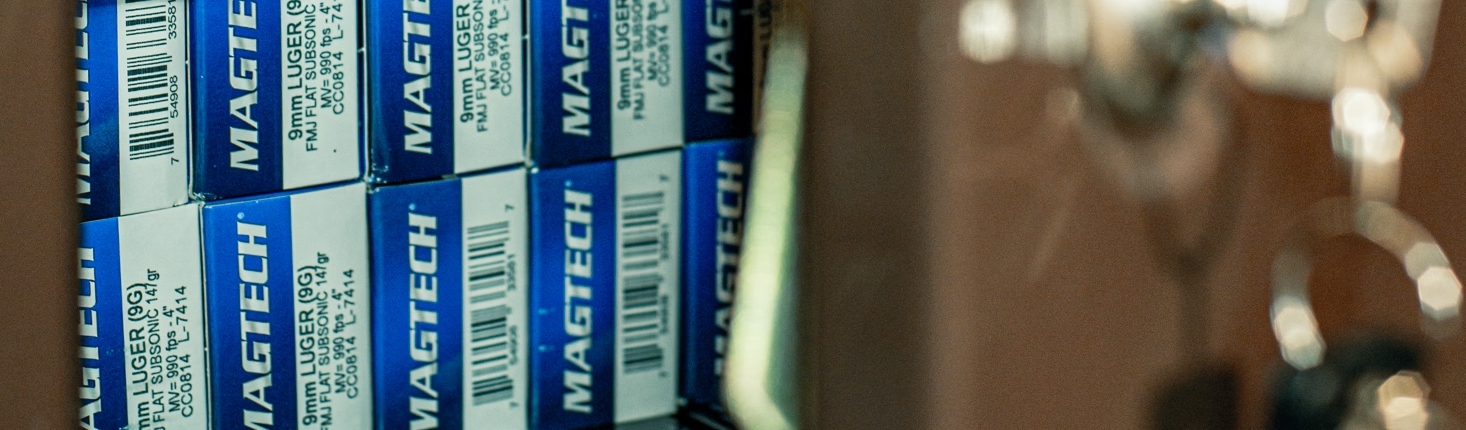
Next question is, now that I have found the proper handgun, what caliber should I get? Well, before we get started on this topic, get the can opener out because this topic always opens a can of worms. This topic has many opinions, and the opinions are like the part of our anatomy that is better off not mentioning! Some say I want the biggest, badest caliber that is practical for self-defense. Some say I want a handgun that is small and easy to shoot with little recoil. For the scope of this article, we will consider the 45 ACP, the 10mm (0.40 Cal) and the 9mm only. So, the answers lie somewhere amidst all those opinions, urban legends, and scientific analysis! In any circle of conversation, the venerable 45 ACP will always be the choice of some or many due to its legendary reputation over decades of use. However, these legends were established when the most common ammo available was either ball ammo, full metal jacket or hard cast bullets all designed with virtually little to no expansion properties for the entire spectrum of handgun calibers. This translates to the 45 ACP punching a 0.451” diameter hole: the 10mm or .40 caliber punching a 0.400” diameter hole and the 9mm punching a 0.355” diameter hole. Therefore, the 45 ACP would always come out as the go-to caliber and still remains one of the most effective for one shot stops. However, development of modern ammo is significantly more effective across all calibers and bullet diameter is somewhat less significant when compared to velocity and bullet expansion. Am I saying the 45 ACP is obsolete? Not at all, I would never make that claim under any circumstances, not to mention the various energy analysis of the 45 ACP versus other calibers. Furthermore, modern ammo has significantly increased the efficiency of calibers, which holds true for the 45 ACP, the 10mm and a host of other calibers.
However, I would not recommend the 45 ACP to a new or inexperienced shooter for a number of reasons to include, but not limited to, the inherent recoil of the 45 ACP by comparison and because of the bullet diameter and mass of the bullet, there is a component of torque associated with each shot fired. These factors can be difficult for seasoned shooters to manage but more evident to new shooters that haven’t yet mastered the art of recoil management or someone who has reduced strength in their hands. The 10mm or 0.400 caliber can actually fall into these categories as well and in fact, with hand loads and proper bullet selection, this caliber can exceed the energy and recoil of some factory loaded 45 ACP rounds in specific and limited applications. So that leaves us with the 9mm. Subsequent to shooting tens of thousands of rounds of 9mm over the years by testing various rounds and calibers in ballistic gel, I believe the 9mm with a 125-grain defense round from a well-established ammo manufacturer is more than efficient for all applications that any civilian would encounter and I make this caliber recommendation for new shooters as well as seasoned shooter. That’s what I carry, the 9mm is my go-to caliber for 80% of my application. Don’t misunderstand what I’m saying. I’m not arguing the point of calculated energy or actual measured energy/velocity of the various calibers mentioned, I am merely stating that the 9mm is more than sufficient for individual defense purposes with modern, specifically designed defense ammo. I always use this analogy in my courses regarding my choice for the 9mm. We all go to the grocery store to purchase food. Normally we go in a passenger car or truck. You could certainly go to the grocery store on a regular basis in a tandem dump truck but is that really necessary, efficient, or practical? It should also be mentioned that we “carry” a firearm a lot more than we civilians use them for defensive purposes. The same holds true when choosing a caliber for your defensive handgun. The other positive issue for choosing a 9mm is the fact that ammo is more cost effective whether you purchase your ammo or reload your ammo, it is still more cost effective by comparison to other calibers and if the ammo is more cost effective, you will most likely be inclined to shoot more. The more you shoot, the better you get, if you have the proper fundamental instruction at the beginning. Doing something incorrectly or inefficiently for years and years doesn’t make it the best way to accomplish your task. It’s been said that practice makes perfect. I say, perfect practice makes a perfect results. In series 3, we will be discussing Concealed Carry accessories.
About the author
Lew Soccorsi brings over 32 years of experience as a firearms instructor, sharing his extensive knowledge and insights on firearms training and safety through the Civilian Defense Training Blog. Specializing in NRA Basic Pistol, Concealed Carry, and advanced tactical training, Lew offers expertise across various levels of Tactical Handgun and Carbine instruction. He holds certifications as an NRA Basic Pistol and Range Instructor, a Handgun Instructor through Sig Academy, and numerous tactical certifications, including a Master Gunsmith Certification. Lew’s depth of experience makes him an invaluable asset to our team.
 The Basics Concepts for Concealed Carry: Intermediate Development Skills: StanceApril 21, 2025 - 7:10 am
 The Basics | Concepts for Concealed Carry: Handgun Manipulation ― ReloadsApril 7, 2025 - 6:55 am









Leave a Reply
Want to join the discussion?Feel free to contribute!